12 Best B2B eCommerce Platforms in 2026
Quick Comparison of the Best B2B Ecommerce Platforms
Need a fast way to evaluate your options? This comparison breaks down the leading B2B eCommerce platforms by G2 rating, best-fit use cases, key features, and starting price, giving you a clear, side-by-side view of what each solution offers.
Key Selection Criteria for B2B eCommerce
The capabilities that separate purpose-built B2B platforms from adapted B2C tools.
- Architecture & Integration
- Order Management & Operations
- Pricing & Customer Management
- Security & Support

Headless vs. purpose-built vs. composable

ERP and CRM integration depth

Multi-org and multi-site management

CPQ, quoting, and RFQ workflows

Scale & performance

Workflow automation

Contract pricing

Customer hierarchy

Built-in CRM vs. integration

Advanced search and discovery

Access control & permissions

Security & compliance

24/7 enterprise support and TCO
Top B2B eCommerce Platform Vendors Comparison
This chart highlights 12 leading B2B eCommerce platforms with proven success in mid-market and enterprise environments, focusing on solutions built to handle complex B2B requirements. Platforms designed primarily for small B2C use cases (like 3dcart or WooCommerce) are excluded due to limited B2B commerce capabilities. Use this comparison to quickly assess strengths, spot limitations, and identify the best fit for your commerce strategy.
Created by the team behind Magento, OroCommerce is a modern eCommerce platform purpose-built for manufacturers, distributors, and wholesalers managing complex sales operations. It bundles CRM, RFQ workflows, CPQ, marketplace capabilities, a CMS, and AI into a single licence.
Every online store runs on native tools for customer accounts, customer-specific pricing, tiered contracts, and custom catalogs. These are core features, not add-ons.
The modular, API-first architecture mirrors B2B operations: approval chains, customer-specific pricing, account hierarchies, custom catalogs, multi-warehouse fulfillment. You control business operations from storefront to backend.
Pre-built connectors for SAP Commerce Cloud, NetSuite, Microsoft Dynamics, and Salesforce integrate your ERP and CRM systems directly. OroCommerce extends existing infrastructure instead of replacing it.
Founded in 2008, Adobe Commerce (formerly Magento) is an open-source eCommerce platform acquired by Adobe and integrated into its Experience Cloud suite. While initially focused on B2C, Adobe Commerce now offers B2B functionalities through add-ons and extensions.
However, its B2C foundation and reliance on third-party solutions for core B2B features can create complexity, particularly for businesses that need customer-specific catalogs or advanced contract pricing out of the box.
Optimizely Configured Commerce leverages its robust CMS technology to deliver enterprise-grade solutions, particularly strong for sophisticated B2C storefronts.
While configurable for B2B, it requires customisation to fully unlock features like advanced price lists, a workflow engine, and digital sales rooms.
Businesses evaluating this as a commerce platform should weigh configuration requirements against purpose-built alternatives, especially if tiered pricing and self-service functionality are priorities.
Founded in 1998 and headquartered in Bengaluru, India, Unilog is a global technology company that developed eCommerce business software with an integrated PIM system.
Its solutions are designed specifically for small and mid-market distributors, manufacturers, and wholesalers, enabling businesses in industrial, electrical, and plumbing sectors to manage inventory and product data from a single interface.
Unilog software is available only through a SaaS model on Google Cloud and Microsoft Azure.
Salesforce Commerce Cloud provides cloud-based solutions for B2B, B2C, and DTC eCommerce.
It is best suited for organisations already relying on CRM systems across their sales and service teams, since its core strength is unifying commerce transactions with existing Salesforce data.
While feature-rich, many functionalities are available as add-ons, potentially increasing costs. Businesses can also explore OroCommerce, which offers a native Salesforce connector to unify CRM data with a purpose-built B2B commerce layer.
Commercetools is a cloud-based headless platform and a well-known composable commerce platform, built on MACH architecture (Microservices, API-first, Cloud-native, and Headless).
While initially focused on B2C, it recently introduced B2B functionalities. As a pre-composed solution, it relies heavily on custom development and integrations.
Businesses should consider the extensive development resources required to build out essential B2B features like workflow automation, which are not included in the core commercetools offering.
Shopware is a German company developing omnichannel cloud eCommerce solutions used predominantly by European customers. It is a reasonable starting point for businesses launching across digital channels in the DACH region.
Because its B2B product is relatively new, Shopware is mainly adopted by smaller brands. Businesses looking to manage multiple brands or scale into complex B2B workflows may find it limited without significant extension work.
Intershop began in 1992 and is a cloud-first B2B software solutions provider. Its eCommerce site infrastructure includes order management and fulfilment, product information management, and experience management, and AI-powered tools like Copilot for Buyers and Product Content
Agent in a single suite.
The platform runs on headless architecture with a Progressive Web App, offering customer-specific pricing, shared carts, and organizational hierarchy management.
In addition to software products, Intershop also provides consulting and training services, reducing reliance on external partners for operational efficiency.
Spryker, positioned as a commerce operating system, takes a modular approach, allowing businesses to assemble a customized eCommerce solution from individual components.
This makes it particularly suited to enterprises building multi-vendor B2B marketplaces or entering new markets with non-standard commerce models.
However, this flexibility requires significant technical expertise. Businesses should ensure they have the development resources to manage multiple sales channels effectively.
BigCommerce is a popular SaaS platform catering to both B2B and B2C businesses. Its B2B Edition operates as a separate app with its own technology stack and API, which can create integration challenges.
Businesses needing to manage multiple brands from a single backend, automate inventory management, or support high transaction volumes may find the native B2B capabilities limiting.
Shopify Plus caters to high-volume businesses seeking a scalable SaaS eCommerce solution. While offering an intuitive interface and an extensive app ecosystem, its strength lies in the B2C and DTC space.
B2B features lack robust support for customer-specific pricing, quote management, or deep ERP and CRM systems integration. Businesses with complex B2B workflows often need to rely on third-party solutions to fill the gaps.
For brands with simpler wholesale needs, it remains the best eCommerce platform for speed to launch.
SAP acquired Hybris in 2013 and rebranded it as SAP Commerce Cloud. Built for organizations already running SAP ERP or S/4HANA, it handles high-volume catalogs across multiple sites and currencies.
The platform shines when your entire backend runs on SAP. Native integration means no middleware layer breaking with every upgrade.
Outside that ecosystem, things get expensive fast. Catalog updates need developers. Non-SAP ERP connections require custom builds. Implementations hit six figures, sometimes seven. You’re paying for SAP-certified talent to do what other platforms include out of the box.
Why OroCommerce Is the Best B2B eCommerce Platform
Most eCommerce platforms were built for consumers, then stretched to fit B2B. OroCommerce wasn’t. Every feature, every workflow, and every line of architecture reflects how B2B actually works.
Purpose-built for operational complexity
Account hierarchies, customer-specific pricing, contract terms, RFQ workflows, approval chains, and custom catalogs are core platform behavior. Cover 70% of B2B requirements out of the box.
Everything included in one license
eCommerce, CRM, CPQ, CMS, marketplace, payments, and AI run on a single platform. Gartner calls this “cost-competitive for a full-suite commerce solution.” Add sales channels, warehouses, or brands at no extra cost.
AI built for B2B operations
OroIQ runs on your unified platform data – pricing, inventory, account history. AI automates workflows, powers self-service portal experiences enhancing customer satisfaction, and surfaces customer behavior insights to drive business success.
Unified commerce architecture
One source of truth for customer data, pricing, and orders across sales teams, portals, and digital channels. Streamline operations by eliminating middleware and data reconciliation between disconnected systems.
Built for multi-brand, multi-region scale
Run B2B, B2C, marketplace, and B2B2X from one instance. Manage multiple brands, legal entities, and regional divisions from a single backend. Customers run 100+ portals and 8M SKUs on one platform.
Deploy on your terms
Choose SaaS, on-premise, or hybrid. Open-source architecture means no vendor lock-in and simplified infrastructure management. Pre-built connectors for SAP Commerce Cloud, NetSuite, Microsoft Dynamics, and Salesforce plug into ERP systems and CRM systems.
B2B Enterprises That Chose OroCommerce
Real businesses achieving measurable growth with a purpose-built B2B platform.
Manufacturing & Distribution
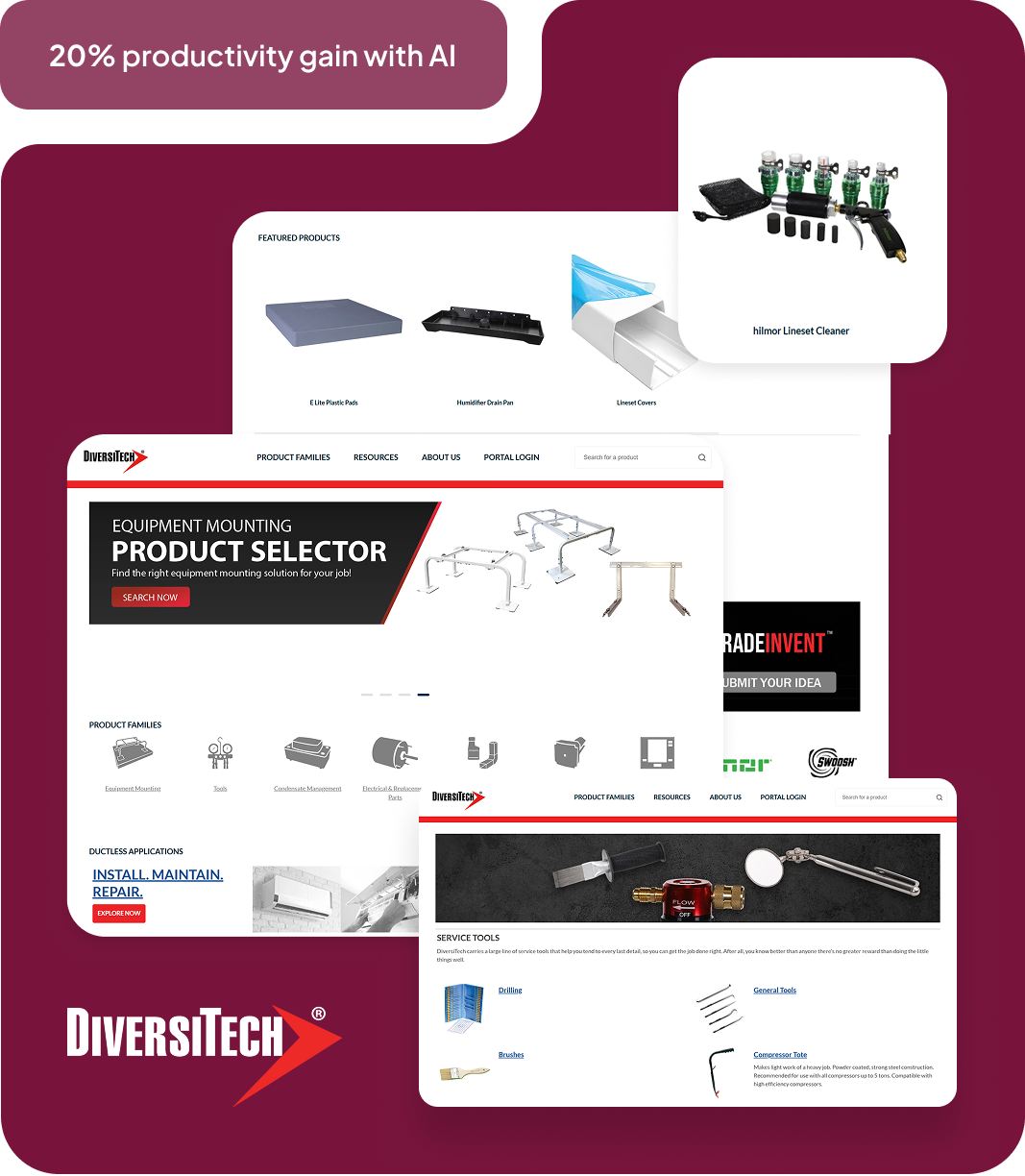
DiversiTech
North America’s largest HVAC components manufacturer and distributor unified commerce operations across 12 ERPs after years of acquisitions.
- Centralized customer portal for orders, tracking, and documents
- AI SmartOrder eliminated manual rekeying
- Automated warranty claim workflows
- Real-time order synchronization from JD Edwards ERP
- Multi-site management supporting distinct brands across regions
Global Food Distribution
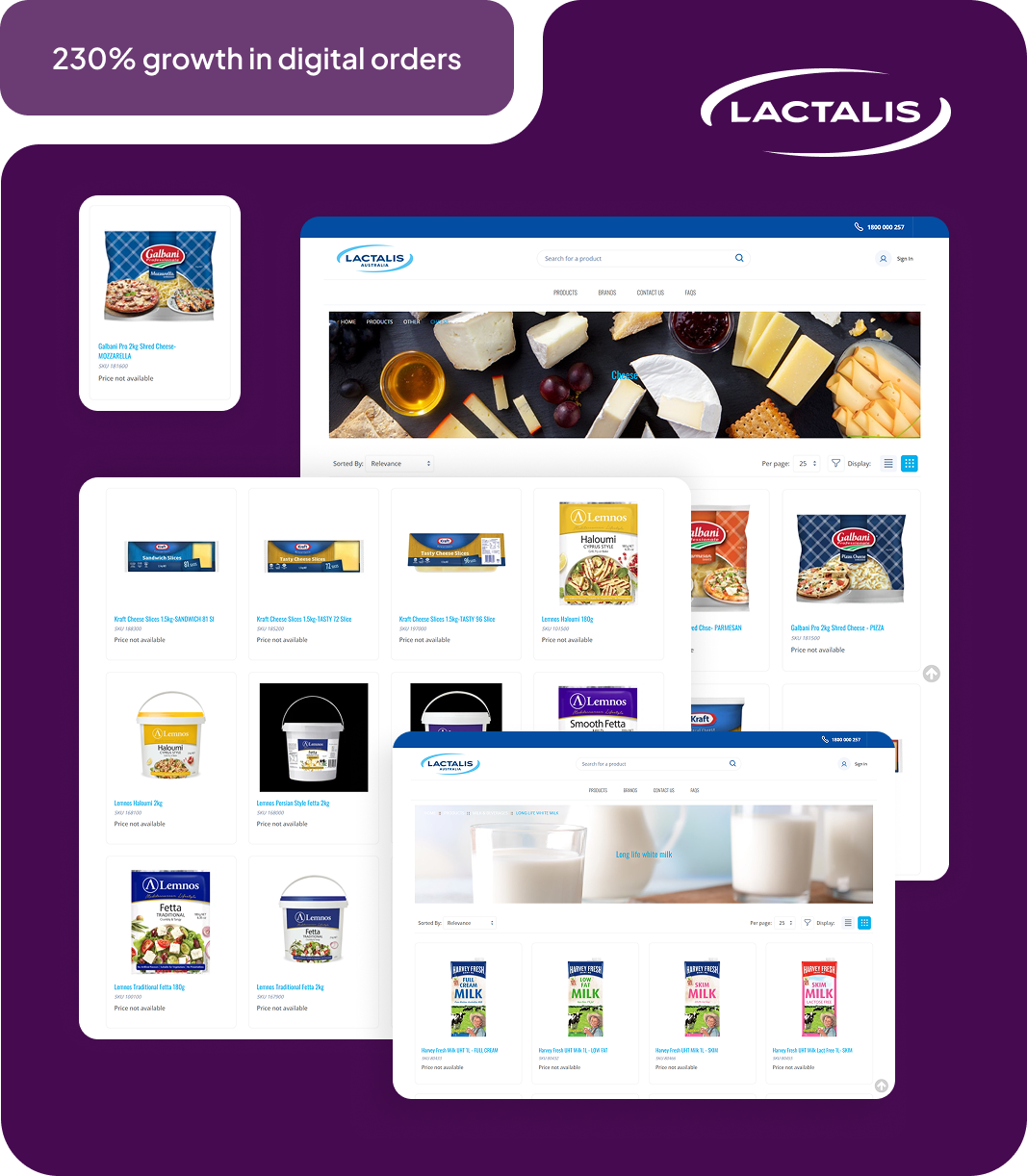
Lactalis
Global dairy leader connected 15,000 customers across 12 markets in two years, reducing manual processes by 44%.
- Efficient portals for placing and tracking orders across regions
- Easy-to-navigate catalogs with detailed product information
- Customizable workflows tailored to local business processes
- D2C channels in regions without distributor networks
- Multi-brand and multi-website capabilities for global operations
Manufacturing & Distribution
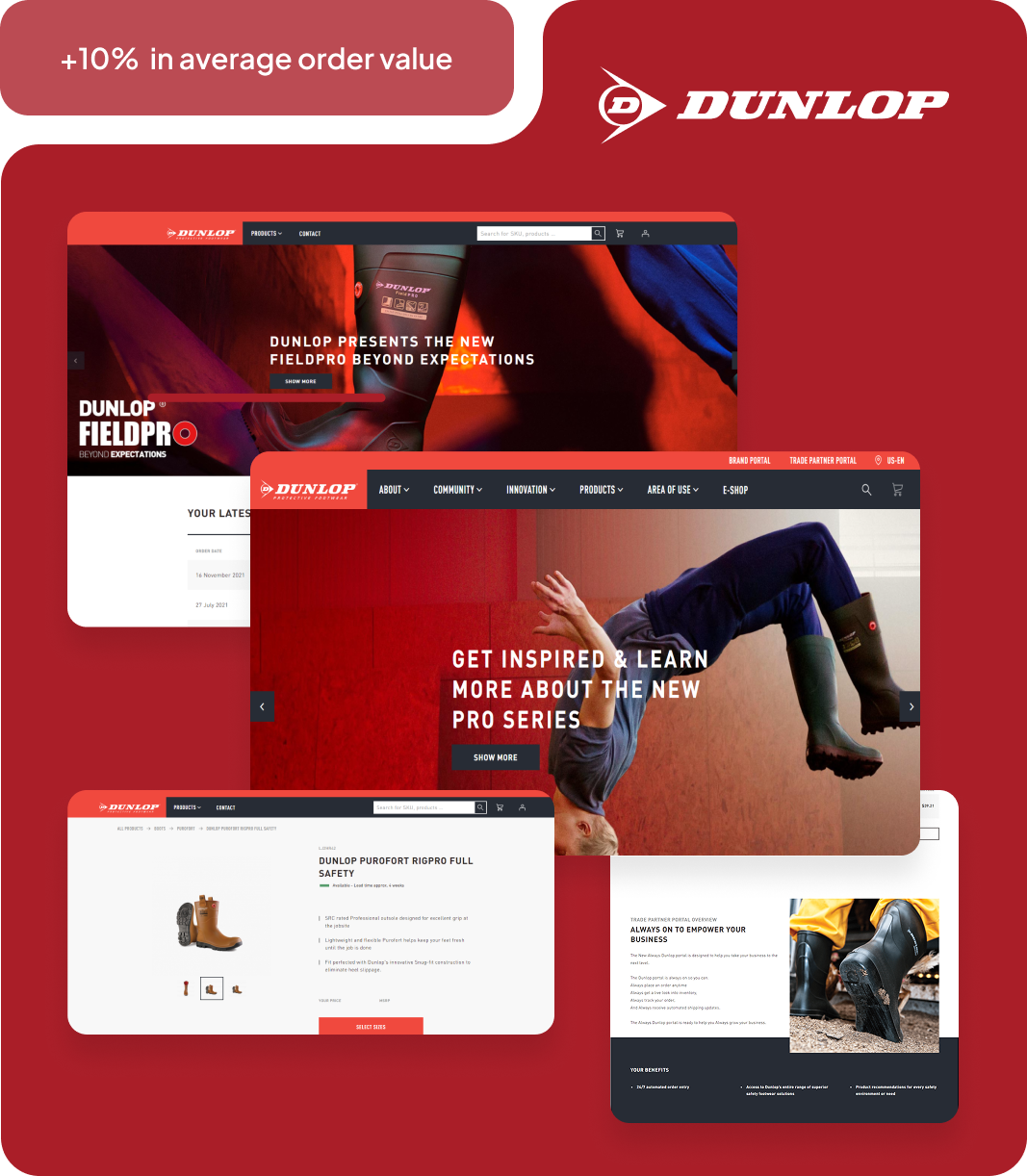
Dunlop Protective Footwear
Global footwear manufacturer scaled digital sales across countries, increasing conversion by 40% and average order value by 10%.
- A responsive website with an easy-to-navigate structure
- The ability to quickly place orders from desktop and mobile apps
- Order history tracking
- Complete stock and pricing transparency
- Country-specific eCommerce websites ensure localized products and promotions
Manufacturing
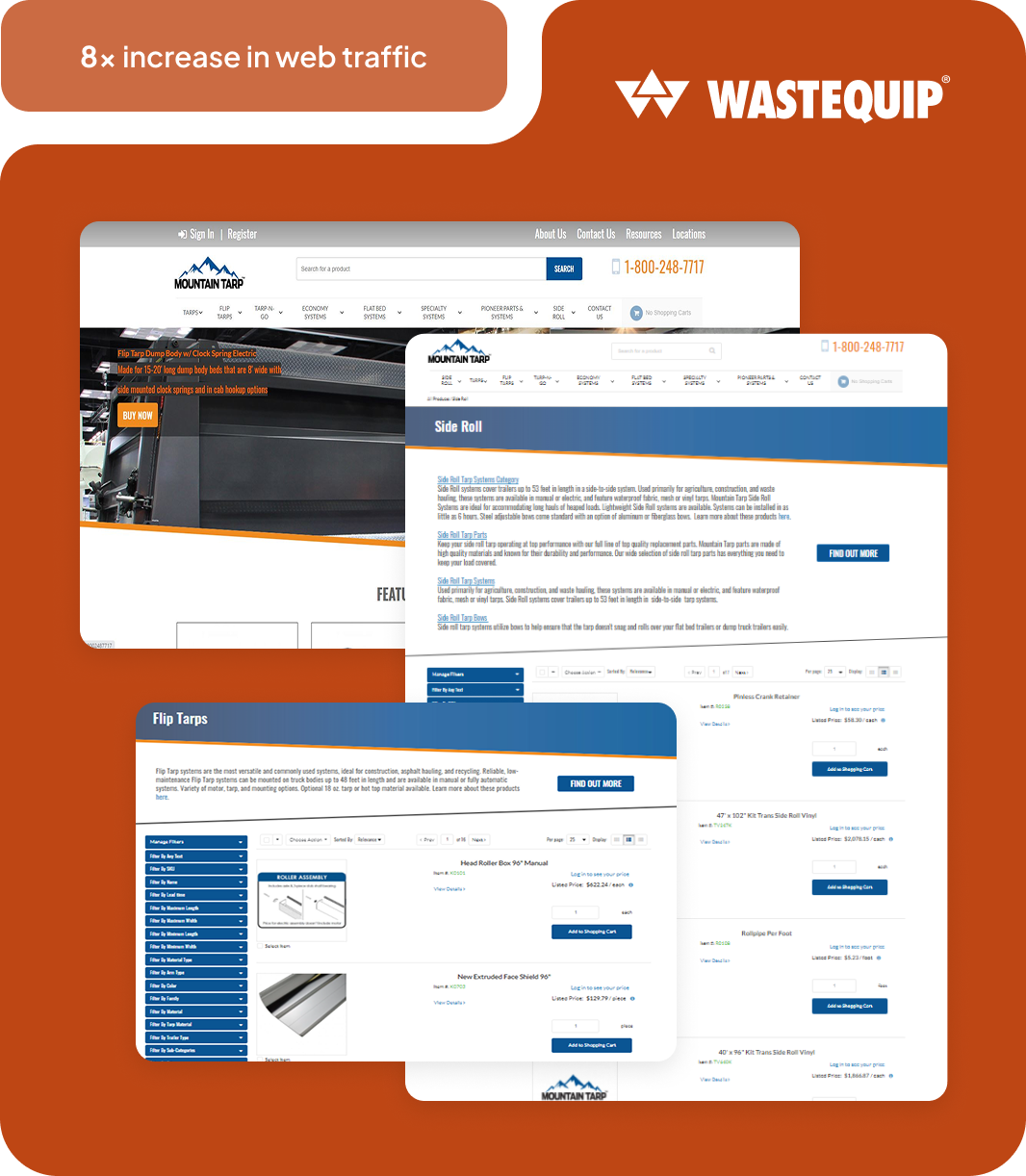
Wastequip
Leading waste-handling equipment manufacturer with 2,000+ employees digitized ordering and saw explosive growth in online adoption.
- Easy navigation with convenient search to quickly find and order products
- Detailed product descriptions and the ability to download product documentation
- Shipping date estimation
- Easy-to-use support options
- Multi-item ordering functionality
Specialty Chemicals Distribution
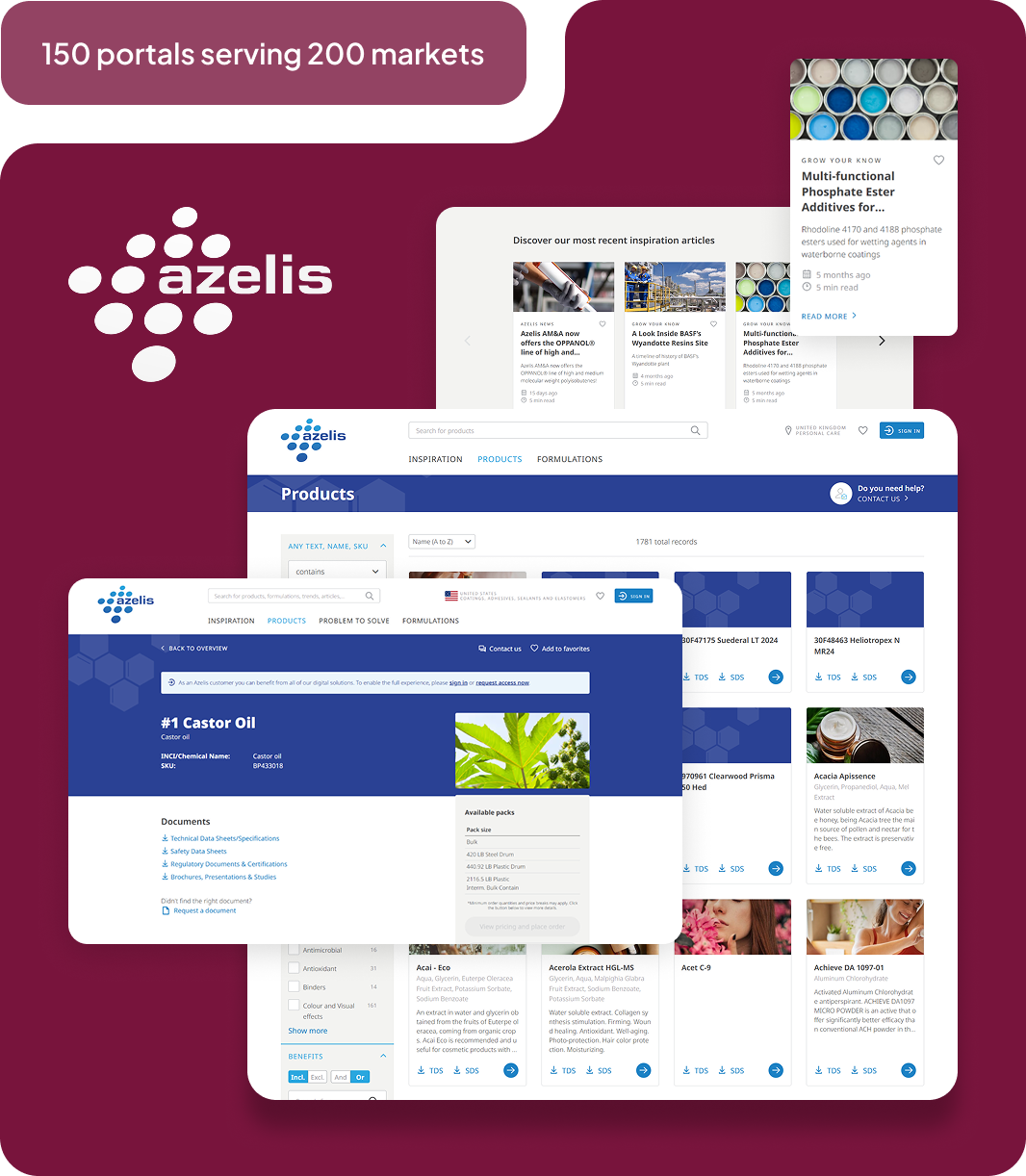
Azelis
Global specialty chemicals distributor digitized operations across 150 portals, serving 65,000 customers with localized catalogs and technical content.
- Multi-site structure managing 150 unique portals from one platform
- Trade agreement logic controlling customer-specific pricing and catalogs
- Self-service access to technical specifications and regulatory documents
- Integration with 70+ innovation labs for formulation guidance
- Market-specific portfolio management through centralized data lake
Aviation Parts Distribution
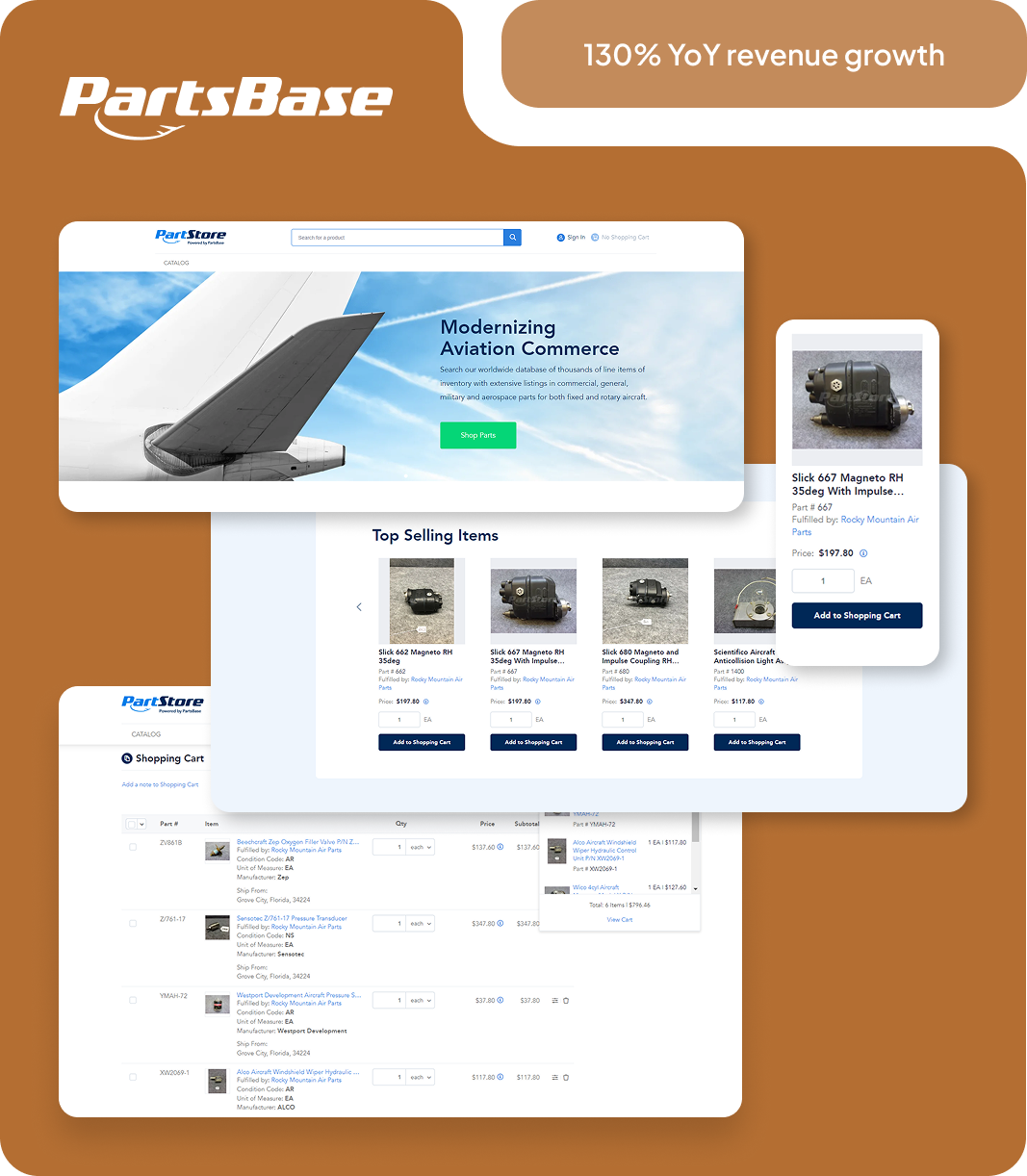
PartsBase
Aviation parts marketplace supporting $2B in annual transactions automated onboarding from days to 5 minutes and launched new self-serve revenue streams.
- Bridge between private member network and public eCommerce store
- Automated PBExpress onboarding bringing in 153 new customers in 2025
- Self-serve booth sales portal generating $100K in first 5 weeks
- Secure data handoff between gated network and checkout
- Real-time tax calculation and vendor payment split automation
Organic Ingredients Distribution
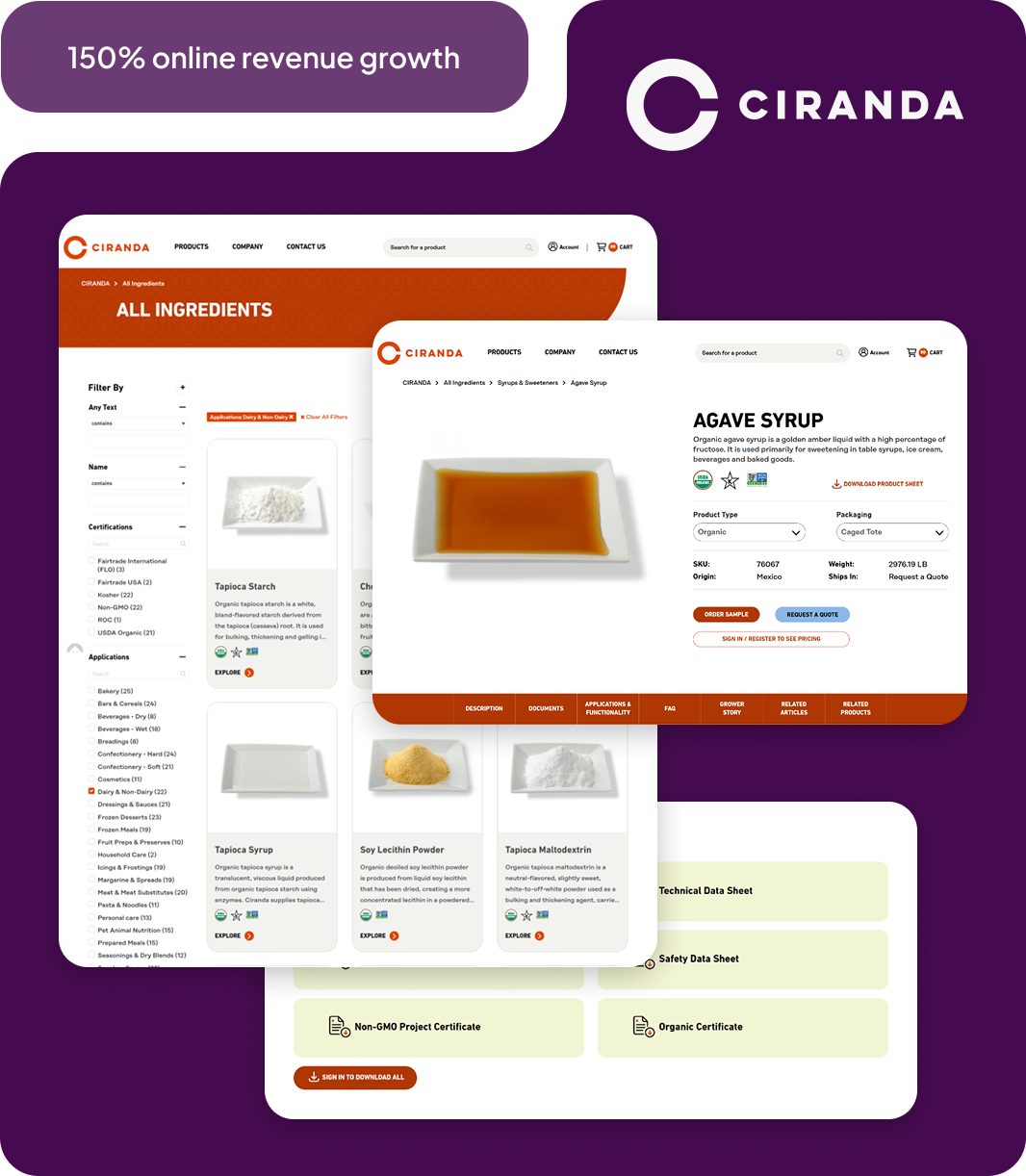
Ciranda
Leading organic ingredients supplier rebuilt its digital channel after Shopify failed, increasing average order value by 80% and online buyers by 45%.
- Deep NetSuite integration for product data, customers, and order history
- Personalized experiences by segment with contract pricing and payment terms
- Self-registration for long-tail accounts with automated quote and sample requests
- All documentation accessible from customer portal dashboard
- Visible account management with dedicated sales rep contact
Distribution
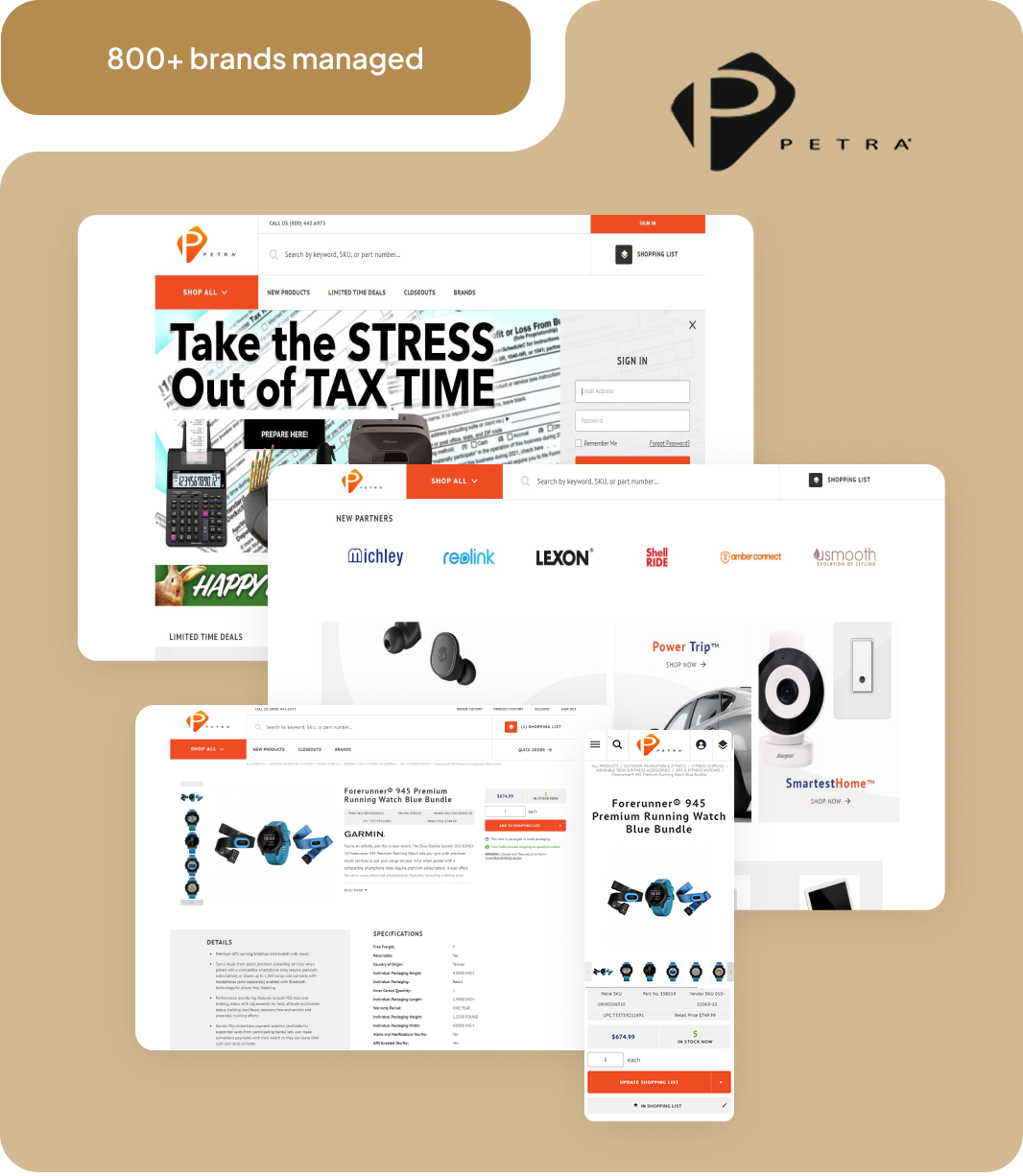
Petra Industries
Leading consumer products distributor serving tens of thousands of retail partners with self-service B2B commerce.
- Quick sales order forms, CSV uploads, and personalized shopping carts
- Site search by keyword, SKU, and part number
- Extensive search filters
- Detailed product descriptions with brand logos
- Multi-login accounts with permissions and flexible approval workflows
B2B eCommerce Platform FAQ
What is a B2B eCommerce platform?
A business-to-business (B2B), also called B-to-B, eCommerce platform enables companies to create an eCommerce store, where businesses (e.g. manufacturing companies, wholesalers, suppliers) can sell goods and services online.
Which eCommerce platform is best for B2B?
The B2B landscape for B2B eCommerce platforms is complex. If you want to offer an outstanding customer experience and make it easy for companies to do business with you online, you need an eCommerce platform developed specifically for B2B.
This means the B2B sales platform should be able to cover between 70% and 80% of B2B functionality out-of-the-box (e.g. order negotiation, complex pricing lists and rules, integration with business systems, etc.).
Additionally, the right eCommerce platform for B2B is modular, flexible, customizable, and powered by artificial intelligence, which means it can be adapted to any B2B use case or channel (desktop, mobile app, etc.), regardless of the industry or vertical.
The only platform on the market today that has been developed to meet complex B2B needs and offer a comprehensive suite of B2B features is OroCommerce.
What is an open-source B2B eCommerce platform?
When you compare B2B eCommerce platforms, it’s important to understand the difference between open-source and proprietary platforms. An open-source B2B eCommerce platform gives you free access to the source code.
This provides the flexibility to adapt the platform to meet your business needs across different B2B, DTC, and wholesale channels. But it also requires IT resources to customize the code or take advantage of code that others have developed.
The key benefits of open-source B2B eCommerce platforms include:
- Greater security as bugs are fixed faster
- Community support
- Open APIs for easier integration
- Generally a lower total cost of ownership
Learn what makes OroCommerce the best open-source B2B eCommerce platform.
What are the must-have B2B features of an enterprise eCommerce platform?
The best B2B eCommerce software streamlines the sales process and improves the customer acquisition and customer satisfaction. When choosing an enterprise eCommerce platform, make sure it has the following features:
- Content and Product Management System – communicate the advantages of your products with product descriptions, videos, certifications, and marketing materials using a wide variety of media types.
- Multiple Price Lists – create and customize as many price lists as you need and manage complex and custom pricing strategies.
- Digitized Order Negotiation and self-service capabilities – easily handle CPQ processes, like requests for quotes and quote to cash transactions.
- Integrations – prevent data silos by seamlessly integrating with your enterprise resource planning system (Microsoft Dynamics, SAP, etc.) WMS, PIM, CRM, and other business systems.
- Access Controls, Roles & Permissions – ensure that users have immediate access but only to the data they need to do their job.
- Corporate Account Management – address complex, hierarchical corporate accounts structures.
- Support for Multiple Organizations, Websites & Stores – control multiple businesses, sub-brands, and divisions from one place.
You can use this list as a starting point for the B2B eCommerce platform comparison.
What are the benefits of selling on a B2B platform?
There are three major benefits of B2B selling through eCommerce platforms like Aliexpress or Alibaba:
- Increased revenue: Selling online helps expand your market reach, and make your products more discoverable, thereby attracting more potential business customers.
- Optimized sales processes: A B2B sales portal lets business buyers place orders 24/7, giving your sales reps data-driven insights to pursue upsell and cross-sell opportunities. It also eliminates manual, repetitive tasks by enabling your sales team to automatically import orders and invoices, send RFQs, and convert quotes to sales.
- Improved customer experience: With a B2B platform, you can make purchasing easy and personalized for businesses, encouraging customer loyalty
How can a versatile eCommerce platform help streamline operations and enhance customer experiences?
A robust SaaS eCommerce solution offers features designed to streamline operations while enhancing customer interactions and meeting specific customer preferences.
- Through extensive customization options and seamless ERP systems integration, businesses can efficiently manage orders and adapt to different customer segments.
- Platforms that support bulk ordering integration, customer relationship management and marketing tools allow sales representatives to provide personalized support, making it easier to track orders, analyze market trends, and respond to changing market dynamics.
These capabilities empower businesses to execute targeted B2B eCommerce strategies that improve customer satisfaction and support long-term growth.