From New Markets to New Models, One Platform to Scale On






A Commerce Foundation You Won’t Outgrow
You’re planning for growth through new markets, new brands, or new business models, and the last thing you want is a platform that caps your ambitions.
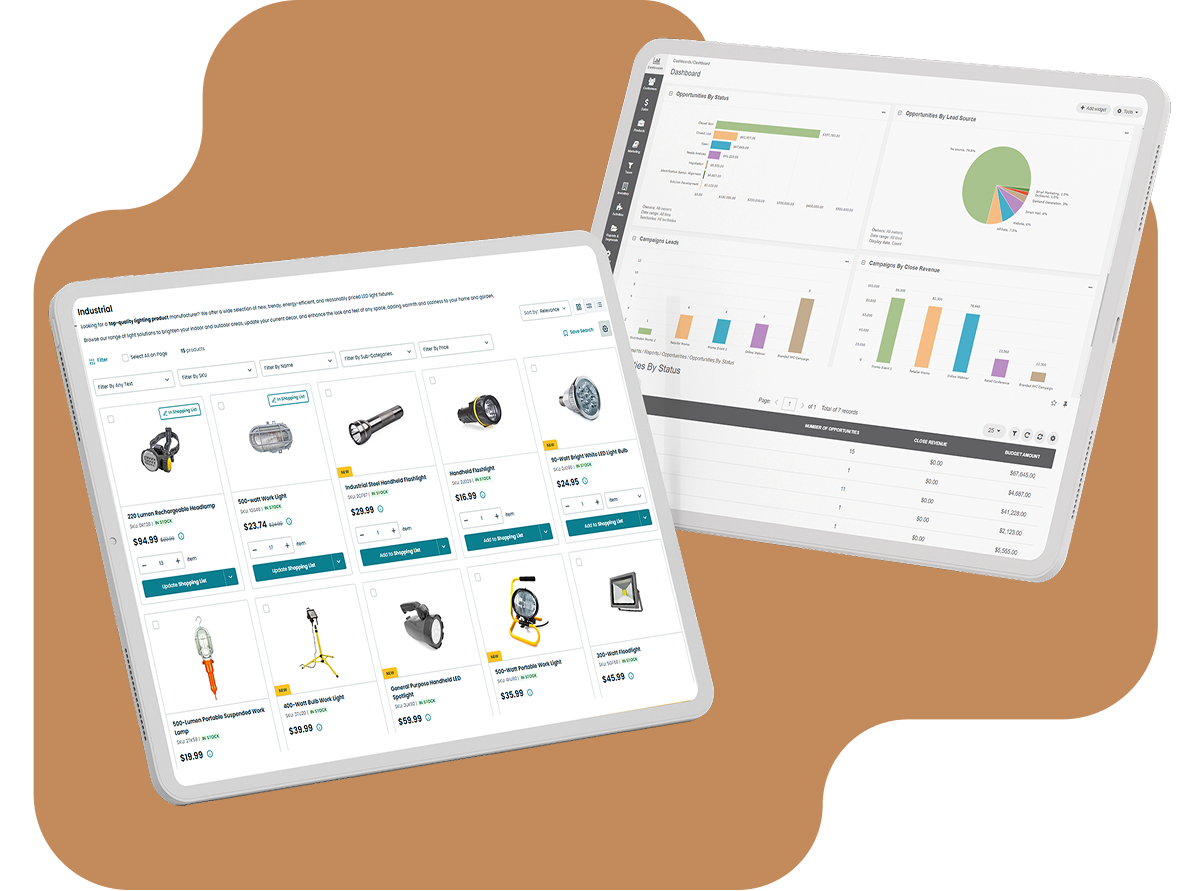
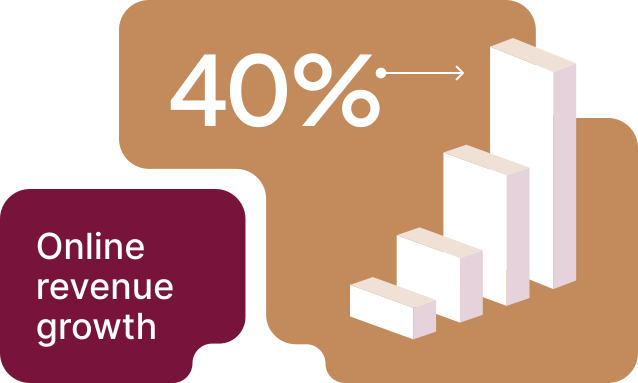
OroCommerce gives you a foundation built for expansion without custom one-offs or endless integrations. Customers often launch in 6-9 months and see 40% YoY online revenue growth – proof that the platform scales as fast as their business.
How OroCommerce Makes Expansion Repeatable
Whether you’re rolling out 90+ sites like Azelis or launching a marketplace like PartsBase OroCommerce gives
you the building blocks to grow in a way that is predictable, manageable, and sustainable.
- Centralized Control With Local Agility
Global manufacturers and distributors often face the choice between central control and regional autonomy. OroCommerce gives you both.
- Repeatable Launch Playbooks
Turn every rollout into a proven playbook instead of a new IT burden.
- Long-Term Architectural Resilience
Avoid replatforming cycles by choosing technology that won’t block you later.
- Adoption That Drives Revenue
The true test of scalability is adoption: if employees and customers don’t use the system, growth stalls. OroCommerce is built to drive usage across the board.
Global manufacturers and distributors often face the choice between central control and regional autonomy. OroCommerce gives you both.
- Multi-org, multi-site, and multi-warehouse support let you add brands, divisions, or regions on the same backbone, without rebuilding.
- Role-based corporate accounts ensure the right buyers, teams, and branches see only the data, terms, and catalogs meant for them.
- Shared modules like CRM, PIM, CPQ, and workflow engine can be standardized centrally, while each market keeps the flexibility to operate locally.
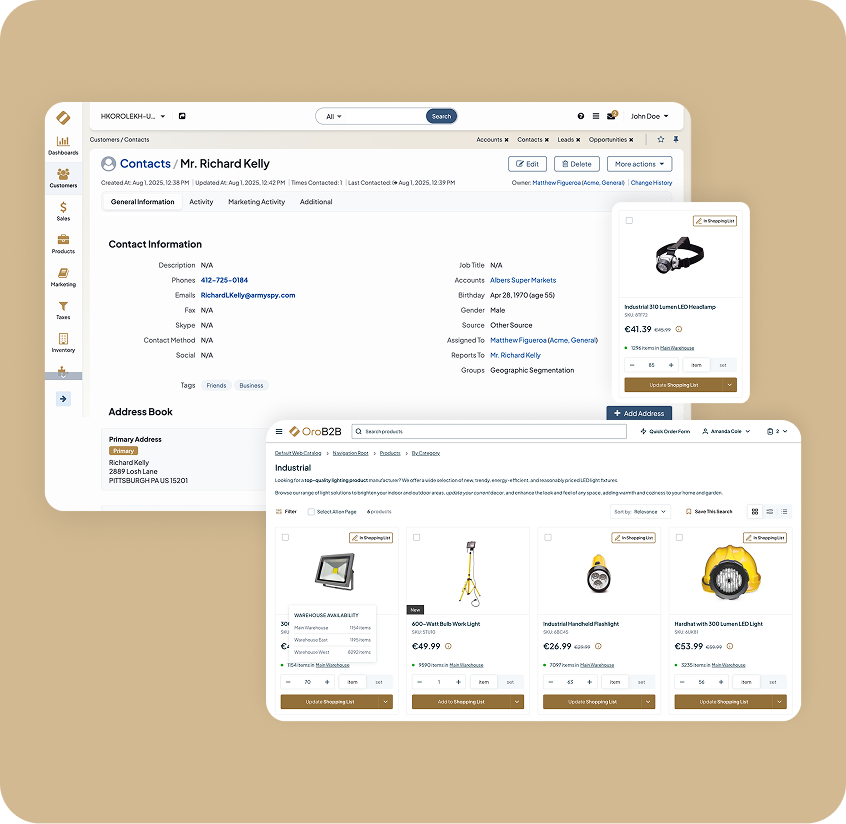
Turn every rollout into a proven playbook instead of a new IT burden.
- Pre-configured support for currencies, languages, tax rules, and units of measure means localization comes standard.
- The workflow engine models approvals, quotes, onboarding, and compliance exactly as each business requires, with no fragile custom code.
- Advanced catalog and pricing tools mean dynamic price lists, tiered pricing, and contract-specific terms are built in, so expansion doesn’t require reinventing pricing logic.
- Template storefronts and portals give IT and digital teams a head start, so adding a new branch or subsidiary is measured in weeks, not quarters.
- Promotions and content templates allow marketing teams to spin up localized campaigns quickly.
Avoid replatforming cycles by choosing technology that won’t block you later.
- API-first integrations keep ERP, OMS, WMS, and procurement platforms in sync without breaking upgrade paths.
- A flexible data model handles large catalogs, rich attributes, and layered price lists, so complexity in your portfolio doesn’t slow you down.
- Built-in CRM, CMS, PIM, CPQ, and multi-vendor marketplace tools eliminate reliance on third-party add-ons, reducing total cost of ownership and future integration risk.
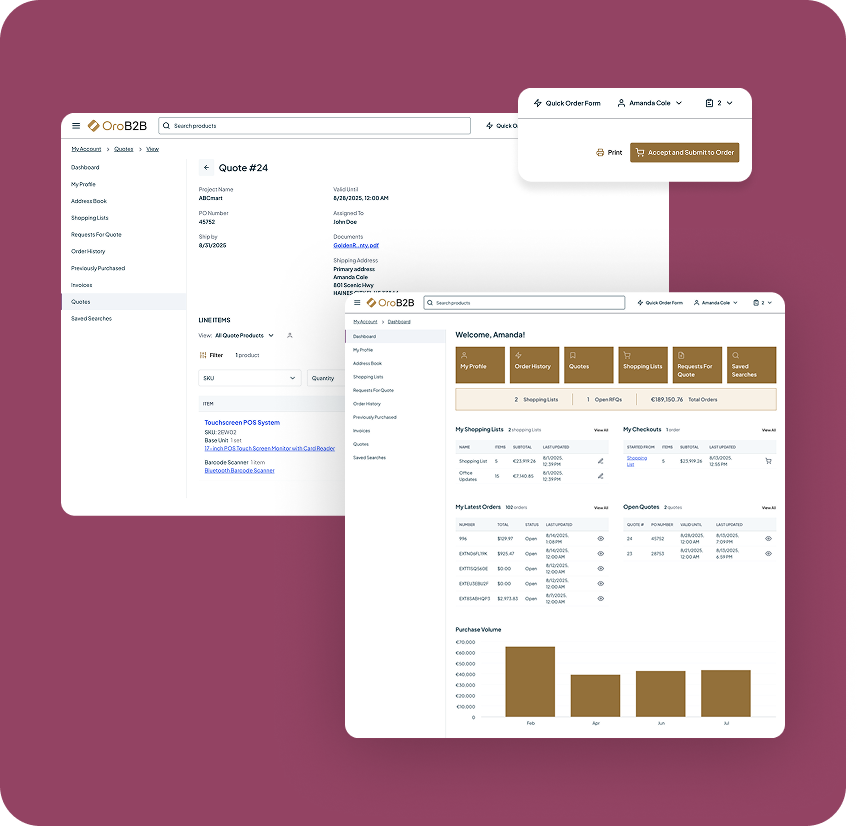
The true test of scalability is adoption: if employees and customers don’t use the system, growth stalls. OroCommerce is built to drive usage across the board.
- For buyers: Account-specific catalogs, personalized pricing, self-service portals, invoice history, recurring orders, and natural-language product search make digital the easiest way to transact.
- For sales teams: Integrated CRM, CPQ, RFQs, account impersonation, and the Field Sales App keep reps productive in the office and on the road. AI SmartOrder cuts manual entry by converting emailed or PDF POs into draft orders for quick review.
- For finance and operations: The Invoice Portal and OroPay simplify invoicing and payments, while role-based dashboards provide visibility into orders, revenue, and adoption trends. Built-in approval chains, audit logs, and access controls ensure governance across growing organizations.

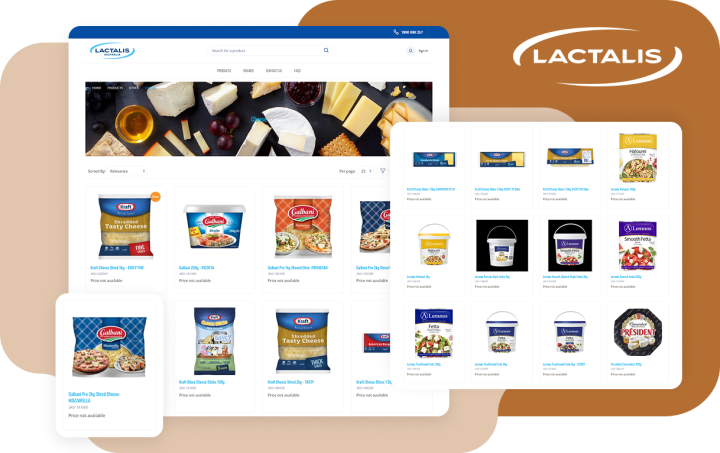
Lactalis Shows What Repeatable Growth Looks Like
When each market runs its own systems, global growth turns into a patchwork of custom projects. Lactalis flipped that script by building one digital model they could roll out anywhere to ensure sustainable growth.
With OroCommerce, the global diary group launched 12 markets on one e Commerce platform in under two years, with digital orders jumping 230%, and manual processes dropping 44%. The same playbook is now fueling expansion across the rest of the business.
Read the full story Why B2B Leaders Choose
OroCommerce for Growth

Purpose-built for complex B2B expansion
Multi-org, multi-site, multi-warehouse, and multi-currency are included from the start. You don’t need fragile workarounds to support acquisitions, regional launches, or new business models.

Scale Proven by 95% Renewal
Customers stay on OroCommerce because it scales with them. A 95% renewal rate after three years proves it can support long-term growth strategies and modern customer experience without costly rebuilds.

Adoption that drives growth
Built-in buyer portals, CRM, invoicing, and payments ensure employees and buyers use the system. That’s why our customers report an average of 40% YoY growth in digital revenue.

Lower cost of ownership
One license covers commerce, CRM, marketplace, CMS, and payments (OroPay). You avoid the overhead of multiple vendors, hidden modules, and unpredictable add-on costs.

Innovation that moves with the industry
AI features such as AI SmartOrder for PO automation and AI SmartAgent for buyer support, together with ongoing AI enhancements and regular releases, ensure your digital channel evolves alongside your business.

Resilient architecture for the long term
API-first integrations, role-based security, and flexible deployment options (cloud, on-prem, or hybrid) give you confidence the platform can handle growth today and in the future.
Featured Resources

How B2B eCommerce Drives AOV and Repeat Business
Learn how a B2B e Commerce platform increases average order value and builds customer loyalty through better online buying experiences.

ROI calculator
Estimate the impact of your eCommerce platform investment—measure potential gains in customer lifetime value, operational efficiency, and conversion rates based on your business goals.

How to Make B2B2X Work
See how a scalable e Commerce platform helps manufacturers and distributors power B2B2X ecosystems, strengthening customer relationships and partner networks.
FAQ
How does OroCommerce handle eCommerce scalability during rapid growth or peak demand?
OroCommerce is designed for eCommerce businesses that need to scale efficiently without downtime or loss of performance. Its cloud infrastructure uses load balancing and multi-server architecture to maintain reliable performance even during peak demand.
Multi-org and multi-site capabilities let you launch new brands, regions, or channels on the same scalable platform, keeping your entire system consistent as you grow.
Can OroCommerce support inventory management and supply chain complexity as we expand?
Yes. OroCommerce connects inventory management across warehouses and integrates with ERPs/WMS for real-time stock, lead times, and backorders, strengthening supply chain management. You can localize for international markets (tax, currency, sales tax rules) while maintaining centralized control and reliable performance.
How can OroCommerce help improve conversion rates and customer retention?
OroCommerce helps increase conversion rates and customer retention by giving every buyer a personalized shopping experience.
You can use built-in dynamic pricing, tailored customer accounts, and AI-driven product recommendations to make each interaction relevant. Combined with integrated marketing automation and email marketing, the platform helps turn new customers into loyal customers who return for repeat purchases.
What KPIs can we track to measure digital growth?
OroCommerce includes advanced analytics and reporting dashboards to monitor key performance indicators that matter, such as conversion rates, customer satisfaction, average order value, and adoption across online shopping channels.
By combining quantitative and qualitative data from the customer journey, you can identify where to optimize performance, strengthen customer retention, and sustain your competitive advantage as the business scales.