OroCommerce Product Roadmap

Strengthening Enterprise Operations
Enterprise deployments need tighter security, cleaner identity management, and infrastructure that holds up under organizational complexity. These updates address those requirements.
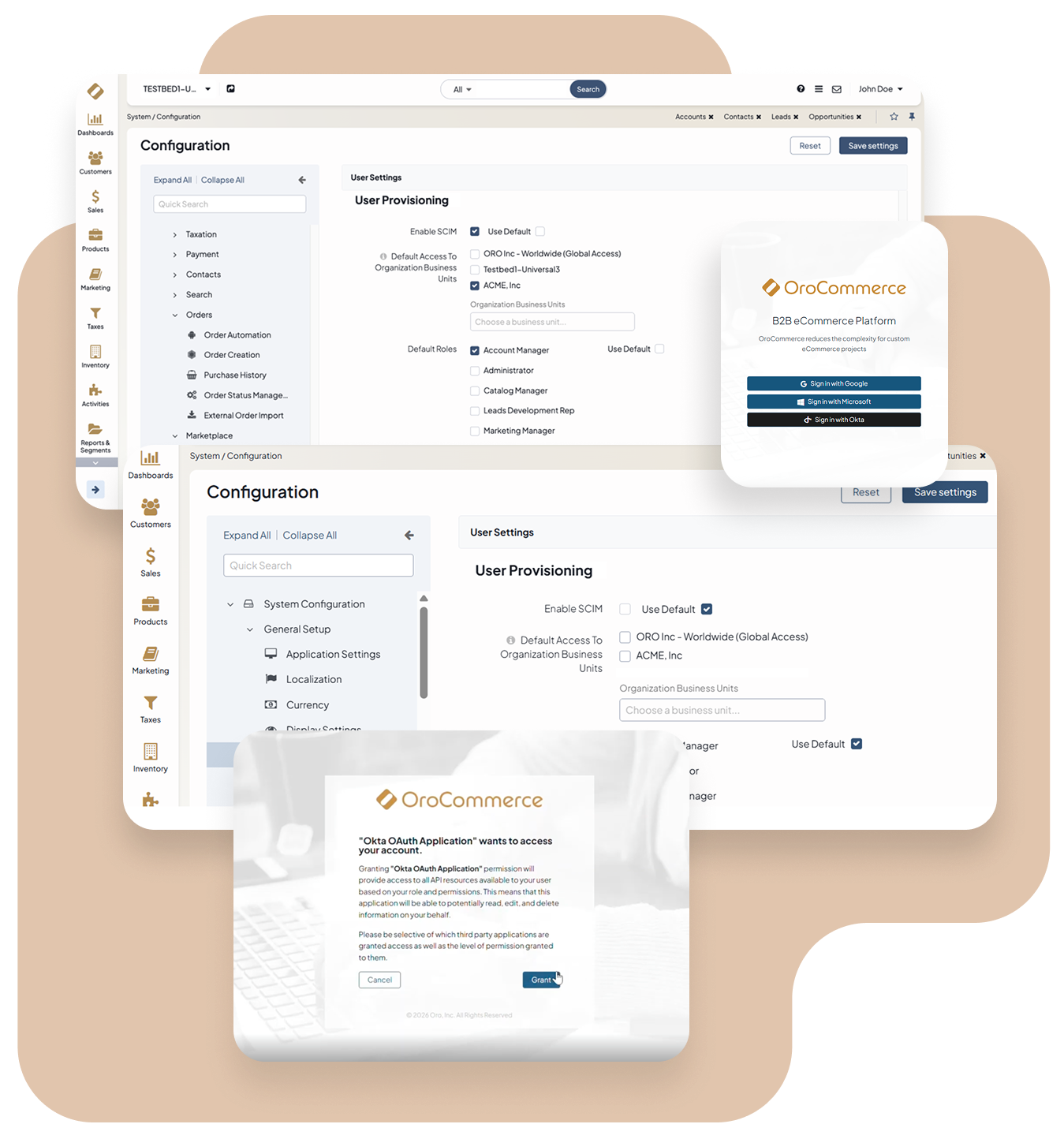
Learn moreStreamlined Identity Management (OIDC & SCIM)
Native OpenID Connect and SCIM support for secure single sign-on and automated user provisioning with identity providers such as Okta and Microsoft Entra.
SSO-Only Logins
Administrators can enforce SSO authentication for specific domains, ensuring employees and partners authenticate through trusted identity providers.
Multi-Currency Price Rules
Pricing formulas now use system exchange rates directly. Price lists adjust automatically as currency rates change.
Advanced Product Import
Product imports support category matching by ID or full category path, improving catalog accuracy in complex product hierarchies.
Organization Selector Upgrade
A new lazy-loading, auto-complete organization selector improves usability and performance in large multi-organization environments.
Security Hardening
Security improvements include stronger SVG sanitization, support for HTTP proxies for Google reCAPTCHA, and a platform upgrade to Symfony 7 for improved performance and modern framework capabilities.
Expanding the Unified B2B Commerce Foundation
When quotes, payments, orders, and inventory live in the same system, deals move faster and fewer things fall through the cracks. These updates tighten that integration, adding native payment options, field sales tools, and order automation that keep the full transaction inside one environment.
Learn moreCustomer Invoicing Portal
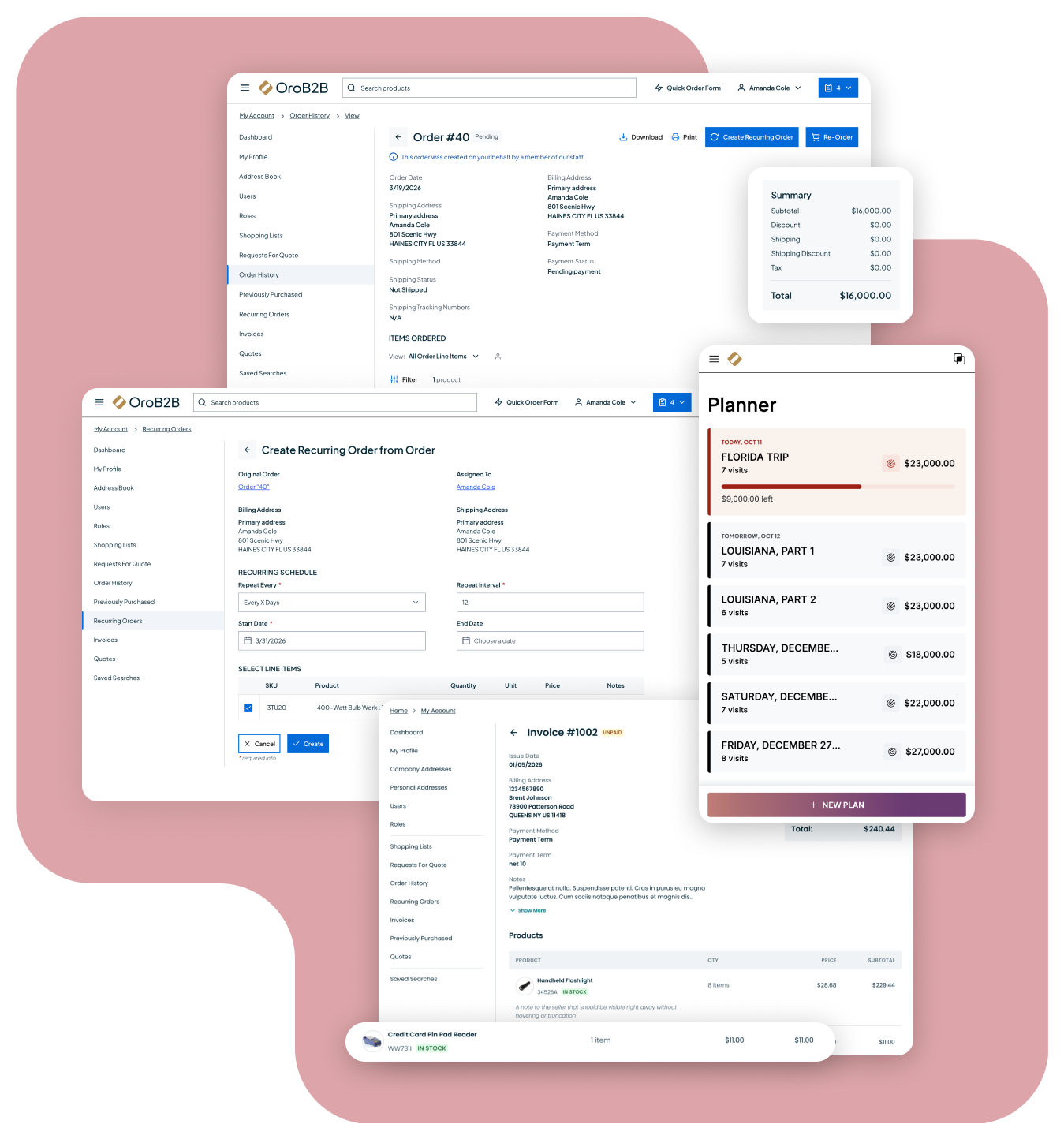
Buyers can view, track, and pay invoices directly from the storefront using OroPay or Stripe Elements. An API supports integration with external invoice systems.
OroPay Integration
A native B2B payment solution built with Global Payments supporting Level 2/3 credit cards and ACH with enterprise-grade compliance.
Field Sales App – Quote Creation
Sales reps can plan and log onsite customer visits, then create quotes directly in the Field Sales app during those interactions.
Recurring Orders
Customers and your service teams can turn past purchases into recurring orders with flexible scheduling and controls, such as pause or cancel.
Inventory Visibility & Order Flexibility
Real-time inventory levels per warehouse are visible across product listings, search results, and checkout. Buyers can move unavailable items to a Save for Later section in shopping lists to avoid checkout disruptions.
Practical AI Tools that Work Out-of-the-Box
OroIQ, OroCommerce’s native AI layer, is already delivering value for customers. Recent OroIQ updates focused on speed and accuracy.
Learn moreOroIQ
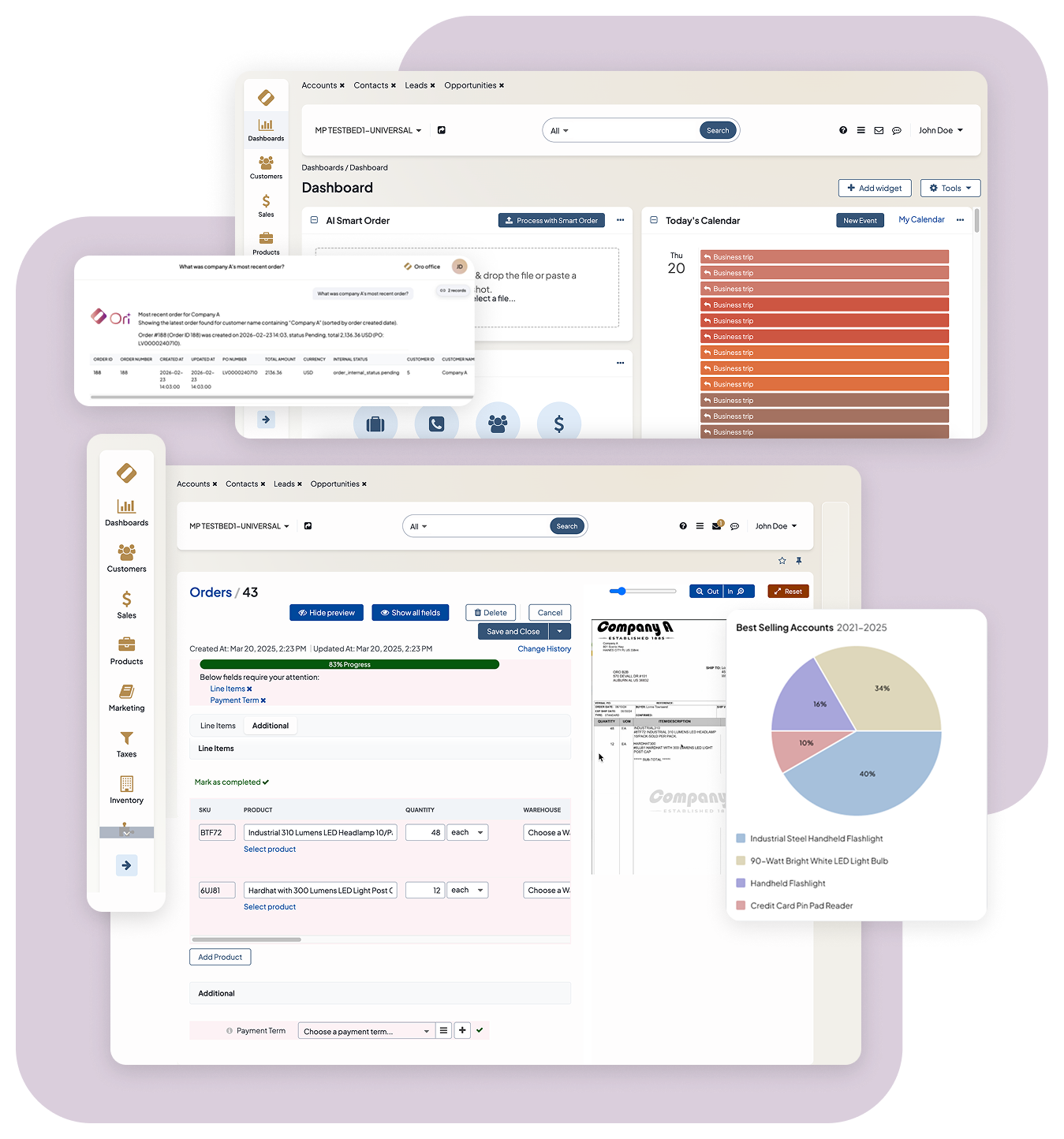
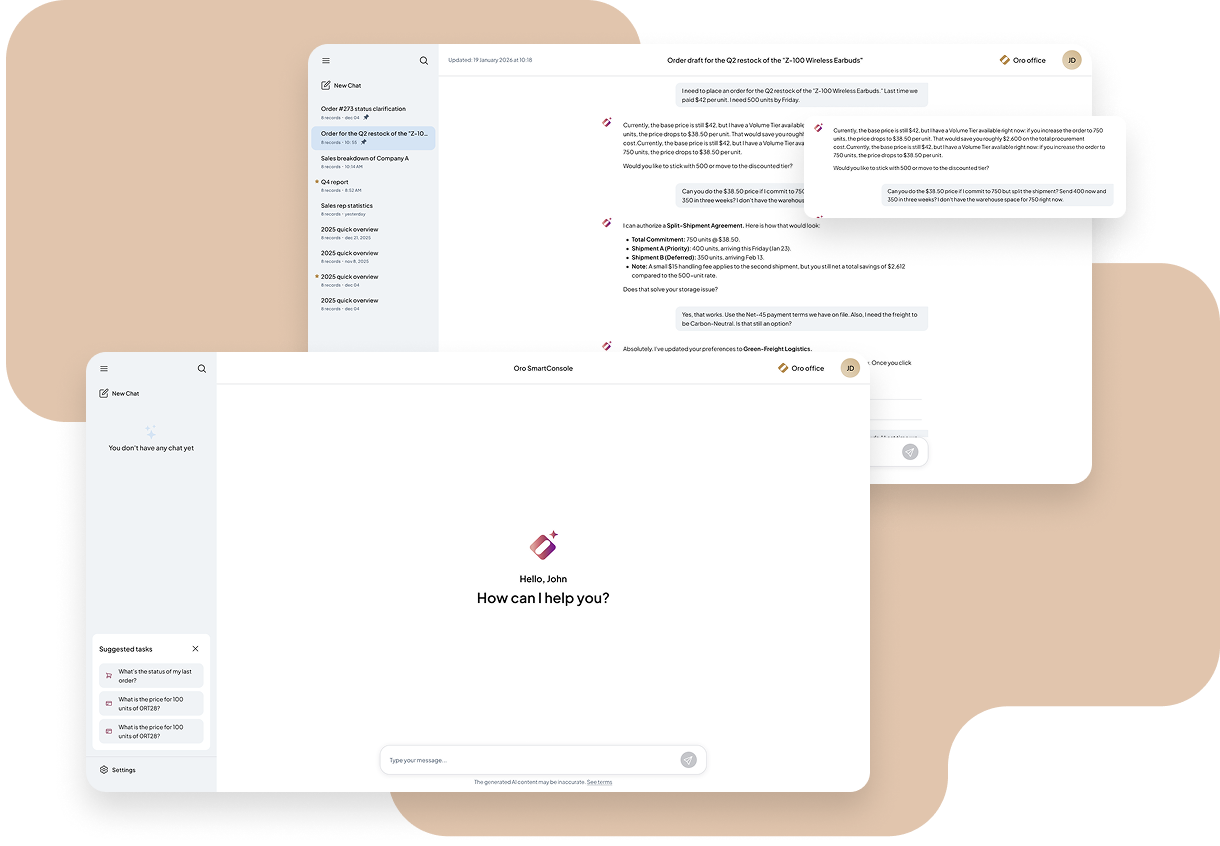
The AI orchestrator and conversational interface for all OroCommerce AI capabilities. OroIQ is the gateway to every AI co-pilot and feature. Query data, execute tasks, and access tools like SmartAssistant and SmartInsights through one natural language console.
SmartOrder
Our PDF (image, doc) PO to digital order converter, now supports Customer Product Numbers (CPNs), mapping customer-specific product identifiers to internal SKUs during purchase order processing. Improved AI recognition can now process documents with 700+ line items in about 30 seconds.
SmartInsights
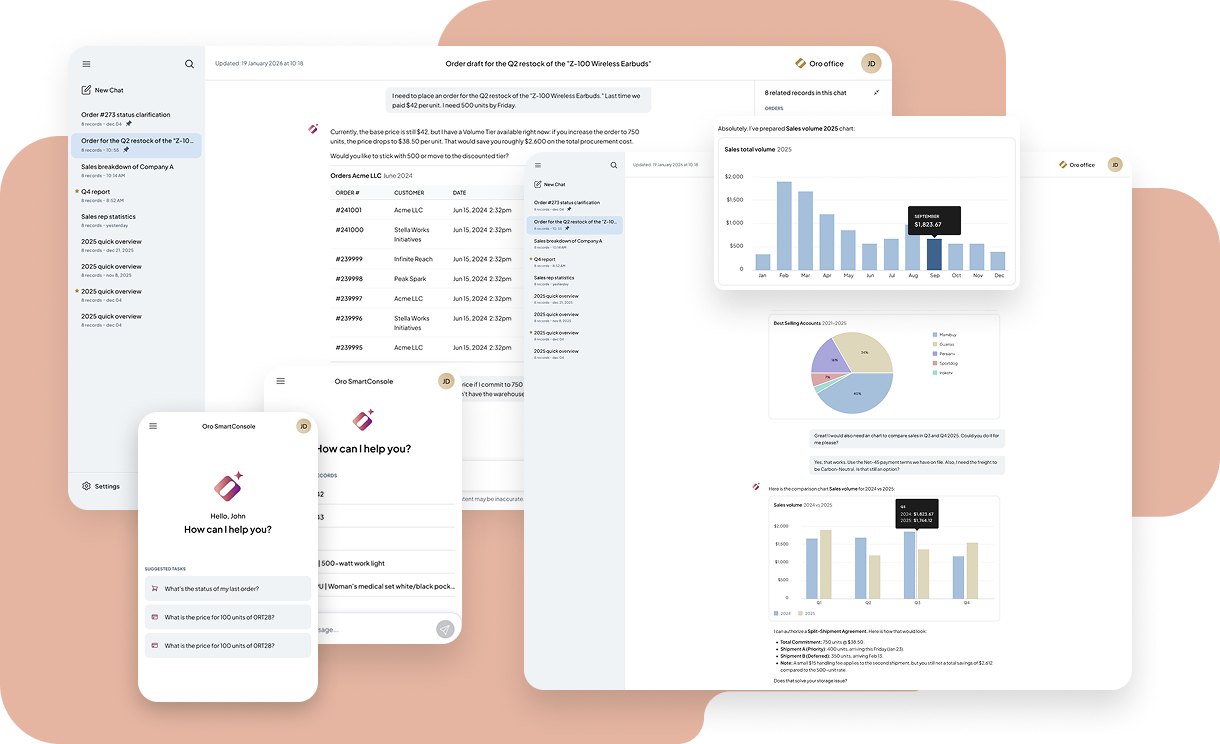
AI-powered analytics co-pilot that lets users query business data in plain English and instantly generate charts, tables, and KPIs. Access follows existing roles and permissions for secure data governance.
Gemini Model Adoption
OroCommerce is transitioning its AI capabilities to Google Gemini models to deliver faster responses and improved accuracy.
Core Commerce Enhancements
Extending payment flexibility, product catalog scope, and deal collaboration to handle more of the complexity B2B teams face daily.
Learn moreExpanded OroPay Capabilities
OroPay will support partial invoice payments, multi-invoice transactions, digital wallets, and saved payment credentials. Buyers get faster checkout, finance teams handle split payments internally.
Customer Part Number Support
Buyers will be able to order using their own internal part numbers instead of translating to your SKU structure every time. Reduces friction and ordering errors.
Digital Goods and Services Support
The platform will support digital goods, services, and subscriptions alongside physical inventory. Sell software licenses, consulting packages, and maintenance contracts through the same catalog.
Digital Sales Rooms
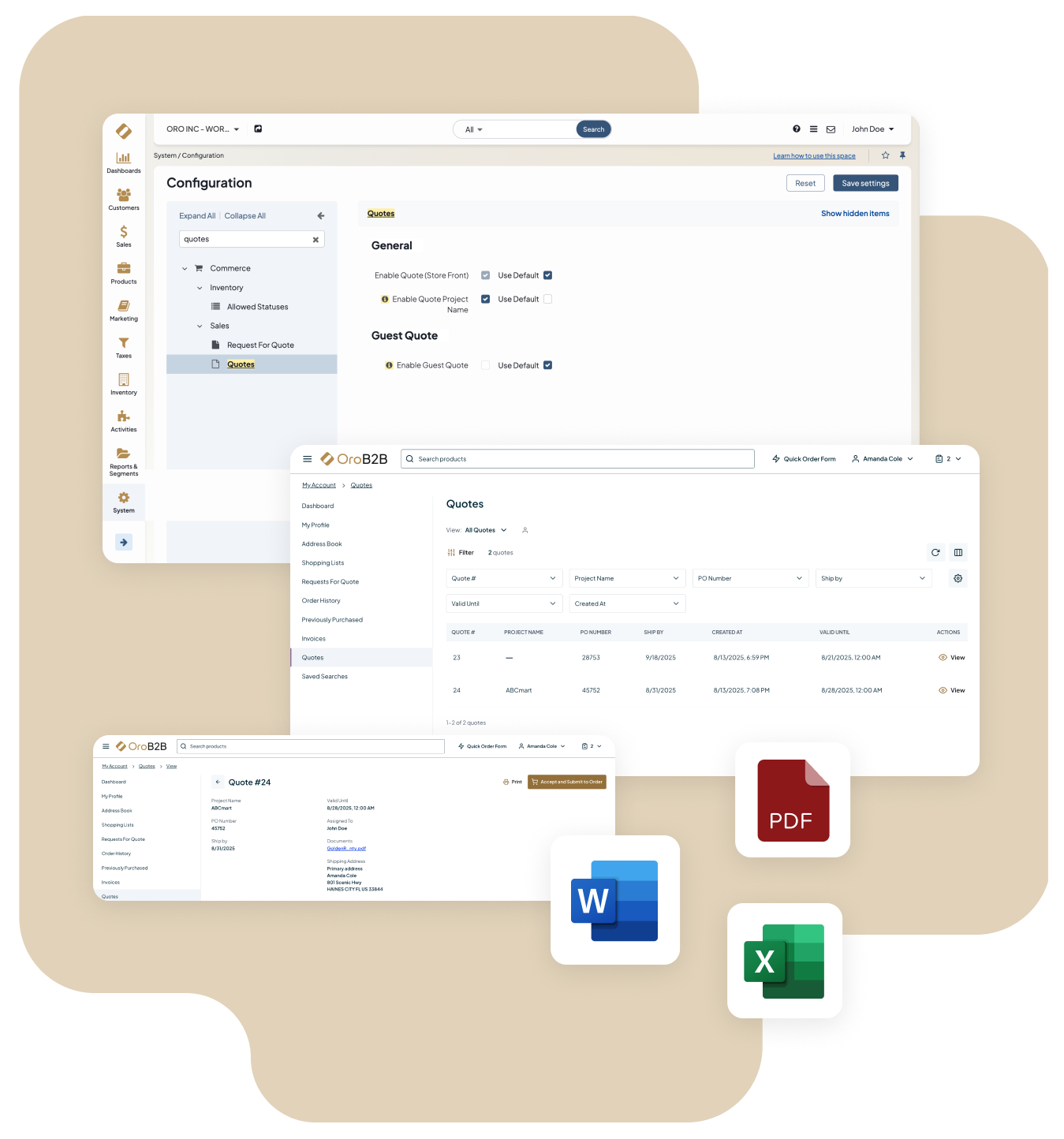
Enhancing existing quote and account collaboration workflows with shared spaces where buyers and sales teams can coordinate around complex deals.
OroIQ: Expanding AI
Across B2B Operations
OroIQ, the AI layer built into OroCommerce, is expanding to cover more B2B workflows. Beyond order automation and data queries, these features monitor business patterns, execute multi-step tasks, and let teams work in natural language. The roadmap has three tracks: production-ready tools teams can use today, infrastructure for building custom AI, and foundations for the coming agentic economy.
AI Tools for Daily Operations
These tools run through OroIQ, the unified AI interface. Each handles a different category of work that teams currently do manually.
SmartAssistant
Task automation assistant you can talk to. Ask it to build a customer segment, create a quote, or assemble a shopping list – it handles the execution. “Find customers who haven’t ordered in 6 months and put them in a new segment” becomes a 10-second instruction instead of clicking through filters, exports, and import screens.
SmartSales Co-Pilot
Pipeline intelligence for sales teams. Analyzes deals in progress and flags where to focus next. Answers questions like “What do I need to move my opportunities from Discovery to Negotiation?” by reading your sales cycles and pointing reps toward the highest-probability work.
SmartTrends
Continuous business monitoring that surfaces shifts before you ask. Flags when a customer starts favoring a specific brand, when sales volume drops, or when buying patterns change. Generates forecasts on demand and tracks product lifecycles, moving teams from reactive analysis to early response.
SmartBlock
Customer and company pages now open with an AI-generated summary of recent orders, quotes, calls, and activity. One readable paragraph instead of scrolling through logs to piece together where things stand.
SmartCards
Ask SmartInsights for a report in plain English, then pin it as a dashboard widget. The chart updates automatically. Build the dashboards you need by describing them, not configuring them.
AI Infrastructure for Custom Development
The layer that lets partners and customers build their own AI agents on top of OroCommerce. These tools provide programmatic access to platform capabilities, prompt management for tuning AI behavior, and orchestration logic for multi-step workflows.
Learn moreMCP Server (Model Context Protocol)
The MCP Server connects your external AI agents to OroCommerce through a standardized API. Instead of rebuilding B2B logic from scratch, your agents tap into the platform’s existing pricing rules, account hierarchies, and approval workflows. First integration point: orders.
Prompts Management and Engineering (LangFuse)
The control panel for AI behavior. Tune prompts, test variations, and track performance across features. When you customize OroIQ tools, LangFuse keeps responses consistent and lets you iterate safely.
AI Agent Orchestration and Logic (LangChain)
Lets AI agents chain tasks together. Query customer data, check pricing, validate inventory, create a quote – all in one sequence. The framework that turns single-action AI into workflow automation.
AI-Accelerated Platform Upgrades
New tooling will streamline and accelerate platform upgrades using AI-assisted processes, reducing effort and risk when moving to new versions of OroCommerce.

Agentic Commerce Readiness
(Open Protocols Support)
Preparing OroCommerce for the next wave of AI-driven commerce. We are building the framework to allow external AI agents to browse, negotiate, and transact on behalf of buyers. By architecting for open, standardized commerce protocols, the platform becomes interoperable with assistants from major ecosystems (like Google or OpenAI) and specialized procurement bots, eliminating the need for hundreds of custom integrations.

Autonomous Transactions
External AI agents discover products, apply discounts, and complete checkouts independently.

Secure Tokenized Payments
Agents transact using tokenized credentials (AP2) instead of handling raw payment data.

Dynamic Capability Discovery
Protocols-compliant agents understand available actions (buy, return, track) through standardized signals, not custom code.